
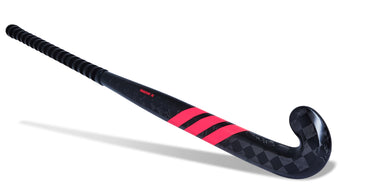
Hockey Stick Buying Guide
How to Choose the Right Hockey Stick
Choosing the right hockey stick can make a huge difference to your performance, confidence and enjoyment of the game. Whether you're buying your very first stick or upgrading to a higher-performance model, understanding what the specifications actually mean will help you make the right choice.
When comparing hockey sticks, you'll notice differences in carbon percentage, bow profile and stick size. Each of these features affects how the stick feels, performs and suits your style of play. While it can be tempting to choose the stick with the highest carbon percentage or the biggest price tag, the best stick is always the one that matches your ability and the way you play.
Below, we'll explain everything you need to know before making your decision.
What Does the Carbon Percentage Mean?
The carbon percentage is one of the most important specifications on any hockey stick. It tells you how much carbon fibre has been used within the construction of the stick, which directly affects its stiffness, responsiveness and power.
Carbon fibre is an incredibly strong and lightweight material. As the carbon content increases, the stick becomes stiffer, allowing it to transfer more energy into the ball when passing, hitting or shooting. This results in more powerful strikes and a faster, more responsive feel.
However, more carbon doesn't automatically mean a better stick for everyone.
Sticks with a lower carbon percentage contain a higher proportion of fibreglass. Fibreglass naturally flexes more than carbon, creating a softer feel when receiving the ball and making the stick much more forgiving if your technique is still developing. This makes lower carbon sticks an excellent choice for beginners, junior players and anyone looking for maximum control.
As you move into mid-range carbon levels, the balance begins to shift. The stick still provides excellent control but offers noticeably more power and responsiveness, making it ideal for regular club hockey.
At the top end, high carbon sticks are designed to maximise performance. Because the shaft flexes less, more of the energy from your swing is transferred directly into the ball, producing faster passes, harder hits and more explosive shots. The trade-off is that high-carbon sticks are less forgiving on mis-hits and generally reward players with more consistent technique.
Rather than asking "What's the highest carbon percentage?", it's better to ask "Which carbon percentage suits my game?" A stick that matches your experience will almost always perform better than one that's beyond your current level.
Quick Summary
- 0–30% Carbon – Softer feel, forgiving and durable. Ideal for beginners and developing players.
- 40–70% Carbon – A balanced blend of control, responsiveness and power. Perfect for regular club players.
- 80–100% Carbon – Maximum power and responsiveness. Best suited to experienced players with consistent technique.
- Higher carbon increases power but also makes the stick less forgiving.
What Do the Different Bow Profiles Mean?
Every hockey stick has a curve built into its shaft, known as the bow. This curve has a significant impact on how the stick performs and influences everything from passing and hitting to aerial skills and drag flicking.
When looking at product specifications, you'll usually see two bow measurements listed:
- Bow Position
- Bow Height
Understanding these two measurements makes choosing the right stick much easier.
Bow Position
Bow Position refers to where the deepest part of the curve sits along the shaft. It is measured from the top of the stick down towards the head and is usually shown in millimetres.
A stick with a higher bow position (around 300mm) places the curve closer to the middle of the shaft. This creates a balanced feel that offers excellent control when passing, receiving and hitting the ball.
As the bow position moves lower down the shaft (250mm or 200mm), the curve sits closer to the head of the stick. This naturally helps lift the ball more easily and supports modern skills such as aerial passes, drag flicks and 3D dribbling.
The lower the bow position, the more the stick is designed to assist with advanced ball manipulation.
Bow Height
Bow Height measures how pronounced the curve is, rather than where it sits. This is normally measured between 22mm and 25mm, with 25mm being the maximum bow permitted under international hockey regulations.
A lower bow height creates a gentler curve that provides a predictable feel and smooth ball control.
A higher bow height creates a more aggressive curve, making it easier to get underneath the ball for lifted passes and advanced skills. It can also help generate greater leverage during drag flicks and quick lifts.
Understanding the Different Bow Types
You'll often see sticks described using names such as Mid Bow, Low Bow or Extra Low Bow. These simply combine the bow position and bow height into an easy-to-understand profile.
- Mid Bow (300mm) – Offers a balanced feel with excellent all-round control and predictable handling.
- Low Bow (250mm) – Makes lifting the ball easier while supporting quicker, more dynamic stick skills.
- Extra Low Bow (200mm) – Places the curve closest to the head for maximum assistance with advanced techniques such as drag flicking and 3D skills.
No bow profile is inherently better than another—it simply depends on the feel you prefer and the types of skills you use most often.
Quick Summary
- Bow Position tells you where the curve sits on the shaft.
- 300mm (Mid Bow) – Balanced control and all-round performance.
- 250mm (Low Bow) – Easier lifting and enhanced modern skills.
- 200mm (Extra Low Bow) – Designed to maximise advanced techniques.
- Bow Height tells you how deep the curve is.
- 22–23mm – More subtle curve with a natural feel.
- 24–25mm – More aggressive curve that helps with lifting the ball and advanced skills.
What Is the Main Difference in Price?
One of the most common questions when buying a hockey stick is why prices can range from under £50 to well over £300.
The biggest difference is the quality of the materials and the technology used during manufacturing.
Entry-level sticks use more fibreglass and simpler construction techniques, making them highly durable and forgiving. They're designed to help players develop confidence and consistency without requiring perfect technique.
As you move through the range, manufacturers use higher percentages of carbon fibre alongside more advanced manufacturing methods. These construction techniques improve how efficiently the stick transfers energy, producing greater power and a more responsive feel while maintaining control.
Premium sticks are engineered for players looking to maximise every aspect of their performance. Small improvements in responsiveness, touch and power can make a noticeable difference at higher levels of the game, which is why elite players often choose these models.
It's also worth remembering that you're not just paying for more carbon. Higher-end sticks often feature more sophisticated layups, reinforced construction and refined manufacturing processes that improve consistency and overall feel.
For most players, a mid-range stick provides the best balance between performance, durability and value.
Quick Summary
- Lower-priced sticks prioritise forgiveness, durability and ease of use.
- Mid-range sticks offer the best balance of control, power and value.
- Premium sticks feature higher carbon content and advanced construction for maximum performance.
- The most expensive stick isn't necessarily the best—choose the one that matches your ability and playing style.
Hockey Stick Size Guide
Choosing the correct stick length is just as important as selecting the right carbon content or bow profile. A correctly sized stick allows you to adopt a comfortable playing position, improves ball control and helps develop good technique.
As a general guide, when standing upright with the stick next to you, the top of the stick should reach approximately your hip bone. While some experienced players may choose a slightly shorter or longer stick based on personal preference, using the correct size is the best starting point for most players.
Use the guide below to find the recommended stick size based on your height.
|
Player Height |
Recommended Stick Size |
|
Up to 92 cm (Up to 3'0") |
24" |
|
92–102 cm (3'0"–3'4") |
26" |
|
102–107 cm (3'4"–3'6") |
27" |
|
107–117 cm (3'6"–3'10") |
28" |
|
117–122 cm (3'10"–4'0") |
30" |
|
122–127 cm (4'0"–4'2") |
31" |
|
127–132 cm (4'2"–4'4") |
32" |
|
132–140 cm (4'4"–4'7") |
33" |
|
140–152 cm (4'7"–5'0") |
34" |
|
152–162 cm (5'0"–5'4") |
35" |
|
162–184 cm (5'4"–6'0") |
36.5" |
|
184–193 cm (6'0"–6'4") |
37.5" |
|
193 cm+ (6'4"+) |
38.5" |
Quick Summary
- Choose your stick size primarily based on your height.
- As a general guide, the top of the stick should reach around your hip bone.
- If you're between sizes, choose the stick that feels most comfortable for your style of play.
- Junior players should avoid buying a stick that's too large to "grow into", as the correct size will help develop better technique and ball control.
Still Not Sure Which Stick Is Right for You?
With so many options available, choosing a hockey stick can feel overwhelming, but it doesn't have to be. By understanding carbon percentage, bow profile and stick size, you'll be able to narrow down the options and choose a stick that suits your game perfectly.
If you need any further advice, our team is always happy to help. Whether you're buying your first stick or investing in a top-level model, we'll help you find the right stick to maximise your enjoyment and performance on the pitch.